
Standee vs. Cutout: What's Actually the Difference?
Posted by Bruce on Aug 7th 2026
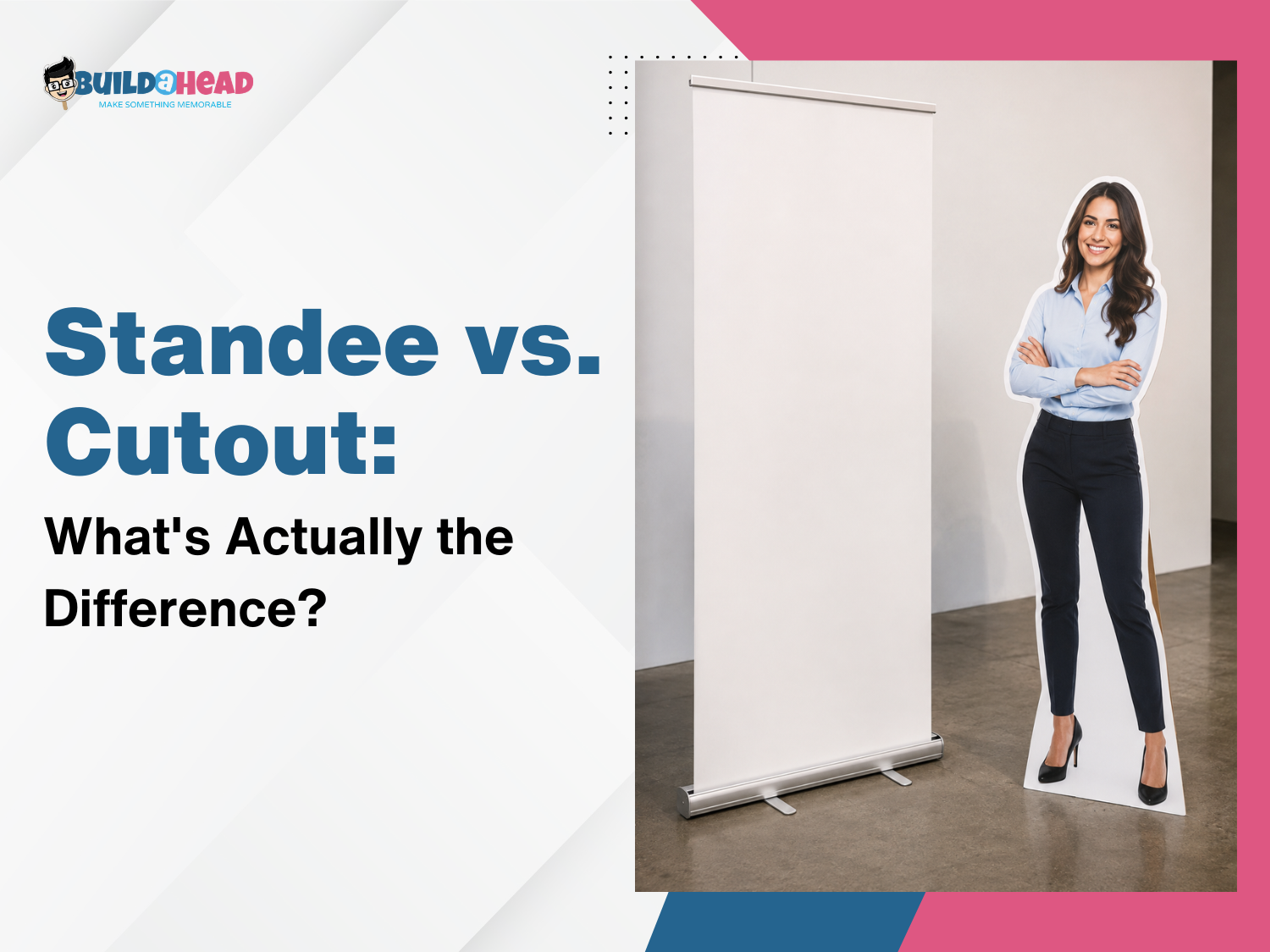
The difference between a standee and a cutout is that a standee is a freestanding display with an integrated support system, whereas a cutout is a custom contour-cut graphic defined by its shape and can be mounted, hung, handheld, or converted into a freestanding display. Although both use similar materials such as cardboard, foam board, corrugated plastic, PVC, and acrylic, they differ in design, purpose, installation, portability, customization, and ideal applications.
Standees are primarily used for promotional, informational, and directional displays in retail stores, exhibitions, trade shows, and receptions, while cutouts are designed to maximize visual impact for photo opportunities, themed events, product replicas, mascots, and movie promotions. Their durability, indoor or outdoor suitability, and lifespan depend more on material quality, print finish, support stability, storage, and environmental exposure than on the display type itself. Understanding these distinctions helps you choose the right display solution based on your branding goals, installation requirements, budget, and intended use.
What Is a Standee?
A standee is a freestanding printed display supported by a base, rear easel, fold-out leg, or rigid frame, designed to present promotional, directional, or decorative graphics without external wall mounting. Produced in formats ranging from compact tabletop units to full-size and life-size displays, standees combine a printed graphic panel, commonly constructed from cardboard, foam board, corrugated plastic, or PVC, with an integrated support mechanism for immediate setup in retail, event, and exhibition spaces. While standard models feature rectangular panels, standees can also be custom contour-cut into life-size human figures, mascots, or product silhouettes, functioning in both indoor and weather-treated outdoor environments as durable, reusable, and portable signage.
What Is a Cutout?
A cutout is a custom-printed display trimmed along a specific outline, such as a person, character, product, or logo, to emphasize a distinct silhouette rather than a traditional rectangular boundary. Available in full-size and life-size formats, cutouts focus primarily on the shape and visual representation of the subject and are manufactured from lightweight rigid substrates, including cardboard, foam board, corrugated plastic, and acrylic. Depending on the intended application, a cutout can be mounted to a wall, hung, used as a handheld photo prop, or transformed into a freestanding display by attaching a separate base or rear easel.
What Is the Difference Between a Standee and a Cutout? Side-by-Side Comparison
The difference between a standee and a cutout includes design, shape, purpose, materials, durability, portability, installation, usage, customization options, and their overall application. Understanding these differences helps you choose the most suitable display solution based on your marketing objectives, installation requirements, and display environment.
Here is a table highlighting the differences between a standee and a cutout:
|
Feature |
Standee |
Cutout |
|
Design |
Combines printed artwork with a freestanding support system such as a rear easel, fold-out leg, or base. |
Focuses on the contour-cut outline of the printed subject, regardless of how it is mounted or supported. |
|
Shape |
Can be rectangular, standard-shaped, or contour-cut with integrated support. |
Usually follows a custom silhouette such as a person, product, mascot, logo, or object. |
|
Purpose |
Designed to display promotional, informational, or directional messages in a self-supporting format. |
Designed to reproduce a recognizable subject where the custom shape creates the primary visual impact. |
|
Materials |
Commonly produced from cardboard, foam board, corrugated plastic, PVC, acrylic, composite panel, or honeycomb board with integrated support. |
Uses the same rigid substrates but emphasizes contour cutting rather than the support structure. |
|
Durability |
Depends on the material, finish, storage, handling, support stability, and environmental exposure. |
Depends on the same factors, with narrow contours and unsupported edges requiring additional protection. |
|
Portability |
Portable when designed with fold-out supports, detachable bases, or flat-pack construction. |
Portable when lightweight materials and suitable packaging protect the custom shape during transport. |
|
Installation |
Installed using rear easels, slot-in bases, weighted bases, or display frames. |
Can be wall-mounted, hung, handheld, placed in a frame, or converted into a freestanding display with a support base. |
|
Indoor vs Outdoor Use |
Suitable for indoor use by default; outdoor use requires weather-resistant materials, UV-stable printing, protective finishing, and stable bases. |
Can also be used outdoors when produced with weather-resistant substrates and installed securely against wind and moisture. |
|
Customization Options |
Customizable in size, artwork, finish, double-sided printing, branded bases, interchangeable graphics, QR codes, and accessories. |
Customizable in contour shape, dimensions, artwork, face openings, layered construction, finishes, and mounting methods. |
|
Best Applications |
Best for retail displays, exhibitions, receptions, product launches, wayfinding, and point-of-purchase promotions. |
Best for photo opportunities, weddings, parties, movie promotions, mascots, product replicas, and themed event displays. |
Design
A standee combines printed artwork with a structural support system that allows it to stand independently, while a cutout focuses on the visible outline of the printed subject. Standee artwork is designed around the printable area, bleed, safe margins, and rear support placement to maintain visual balance without interfering with the display. In contrast, cutout artwork is built around a precise cut path that follows the subject's silhouette, requiring careful spacing around complex edges and narrow sections. In both formats, the front-facing presentation remains the visual focus, but only the standee integrates the support structure into the overall design.
Shape
Standees can be rectangular, standard-shaped, or contour-cut depending on the display requirements, whereas cutouts are defined by a custom outline that follows the exact shape of the printed graphic. Common cutout designs include people, products, characters, mascots, logos, and branded objects with either simple or intricate contours. While standees can incorporate contour-cut graphics, their defining feature is the freestanding support system rather than the shape itself. During production, extremely narrow, extended, or uneven sections may require reinforcement or design adjustments to improve structural integrity, while wider base areas provide greater balance and stability for freestanding displays.
Purpose
For purpose, standees are primarily designed to communicate promotional, informational, or directional messages in a freestanding format, whereas cutouts are created to replicate the shape of a person, character, product, object, or logo for maximum visual impact. This distinction makes standees ideal for retail promotions, product launches, trade shows, reception areas, exhibitions, and wayfinding where clear communication is the priority. In contrast, cutouts are commonly used for photo opportunities, themed events, movie promotions, mascot displays, point-of-sale marketing, and branded campaign installations where the custom silhouette attracts attention, enhances audience engagement, and creates memorable visual experiences.
Materials
In terms of materials, standees prioritize rigid, flat, floor-standing substrates paired with integrated support mechanisms, while cutouts utilize lightweight, easily routable panels optimized for clean contour cutting and versatile mounting. The choice of material influences rigidity, finish, moisture resistance, expected reuse, indoor or outdoor suitability, production cost, and recycling options rather than whether the display is classified as a standee or a cutout.
- Cardboard (Corrugated / Paperboard): For standees, it provides a cost-effective flat surface easily backed by a fold-out easel, whereas for cutouts, it offers simple die-cutting for event props, though both suffer edge wear if exposed to moisture.
- Foam Board: Delivers vibrant graphics for indoor standees on table-tops or easels, while for cutouts, it allows smooth knife-edge trimming, though its fragile edges make complex cutout silhouettes prone to denting.
- Corrugated Plastic (Coroplast): Supplies excellent structural rigidity for freestanding outdoor standees with stake bases, while its easy-routing properties allow weather-proof outdoor cutouts to maintain clean silhouettes without warping.
- PVC Board (Expanded PVC / Forex): In standees, it yields strong self-supporting panels that will not flex, in cutouts, its solid core supports intricate CNC contouring, crisp corners, and heavy-duty wall mounting.
- Honeycomb Board: Keeps extra-large promotional standees perfectly flat without bending, while providing eco-friendly cutouts with strong internal support for broad shapes.
Durability
When it comes to durability, standees last as long as their supporting bases and hinge mechanisms remain structurally sound, while cutouts last based on the resilience of their cut edges and perimeter corners. However, the durability of both standees and cutouts depends primarily on the material, print finish, storage conditions, handling practices, and environmental exposure rather than the product name itself. Moisture, UV exposure, wind, edge damage, bending, fading, delamination, folding wear, and unstable bases all influence performance over time. Proper flat storage, protective packaging, dry environments, and careful transport significantly improve the usable life of either display, while expected lifespan should always follow the manufacturer's material specifications.
Portability
For portability, standees are easier to transport as complete freestanding displays because they often feature flat-pack construction, fold-out easels, and detachable bases, whereas cutouts consist of lightweight contour-cut panels that may require larger protective packaging to prevent edge damage during transit. Standees are designed for quick assembly and repeated use, making them a practical choice for trade shows, retail promotions, and traveling events. Cutouts are also lightweight and easy to handle, but intricate shapes and extended edges may require extra care during packing and shipping. Overall, portability depends on panel dimensions, substrate weight, packaging size, support design, and the frequency of setup, relocation, and reuse.
Installation
In terms of installation, standees rely on built-in or slot-in base mechanisms for fast, tool-free floor deployment, whereas cutouts offer broad mounting flexibility including wall attachment, ceiling suspension, handheld use, or added rear easel stands. The installation method directly affects setup time, stability, surface compatibility, removability, and the overall suitability of the display for indoor or outdoor environments.
- Rear Easels: For standees, they provide essential freestanding support on flat floors, whereas for cutouts, they transform an otherwise flat wall prop into a self-standing display.
- Slot-In Floor Bases: Give rectangular or contoured standees a clean, low-profile footprint on hard floors, while allowing custom cutouts to slide securely into a base without obscuring the subject's outline.
- Weighted Bases: Prevent tall promotional standees from tipping in windy conditions, while anchoring large, top-heavy outdoor cutouts against wind resistance.
- Adhesive Mounting: Rarely used for floor standees, this method allows lightweight cutouts to mount directly to walls, pillars, or retail fixtures with clean removability.
- Wall Fixing Hardware: Unsuited for temporary standees, these hardware options provide permanent structural anchoring for rigid PVC or composite cutouts in architectural and retail environments.
Indoor vs Outdoor Use
For indoor use, both standees and cutouts perform exceptionally well because standard materials such as cardboard and foam board remain stable in controlled environments. For outdoor use, both formats require weather-resistant substrates such as corrugated plastic, expanded PVC, or aluminum composite panels together with UV-resistant printing, protective lamination, and securely weighted support systems. Environmental conditions including wind, rain, moisture, sunlight, temperature variation, and drainage directly affect display performance. Untreated cardboard and conventional foam board should only be used indoors because prolonged outdoor exposure rapidly causes warping and structural failure.
Customization Options
When it comes to customization, standees focus on adapting both the display graphics and freestanding support system, whereas cutouts emphasize custom silhouettes, interactive designs, and creative finishing options. Both display formats can be tailored to meet specific branding, promotional, and functional requirements through a wide range of production and finishing options.
- Custom Dimensions: Scaling standees depends on available floor space and structural height limits, whereas cutouts are dimensioned to match exact human scale or real-world product proportions.
- Contour Precision Cutting: Applying cut paths to standees defines decorative top headers or outer borders, while precision CNC routing traces intricate subject silhouettes for cutouts.
- Double-Sided Printing: Printing both sides of a standee captures foot traffic from opposing directions in high-volume aisles, while dual-sided cutouts yield versatile, reversible photo props and overhead hanging displays.
- Matte vs. Gloss Finishing: Selecting a gloss finish enhances color saturation and visual punch on promotional standees, while glare-resistant matte coatings suit cutouts meant for flash photography and media events.
- Protective Lamination: Overlaying film on large standee panels prevents surface scuffing in high-traffic zones, while laminating cutouts reinforces fragile perimeter edges against thumbprints and handling damage.
- Interchangeable Graphics: Adding modular header inserts or magnetic strips allows standees to display updated promotional offers, whereas cutouts are manufactured as fixed, single-piece visual displays.
Best Applications
Standees are often used in retail entrances, aisle endcaps, trade show booths, reception desks, and checkout queues to present promotional, directional, or informational messages, while cutouts are more commonly used in photo booths, party activations, movie promotions, mascot displays, and product replicas where the custom silhouette forms the main visual feature. The most suitable option depends on whether the priority is delivering a freestanding message or creating a visually recognizable shape that attracts attention and encourages interaction. In many marketing campaigns, businesses combine contour-cut standees with integrated support systems to achieve the visual impact of a cutout while maintaining the stability and convenience of a freestanding display.
What Are the Similarities Between Standees and Cutouts?
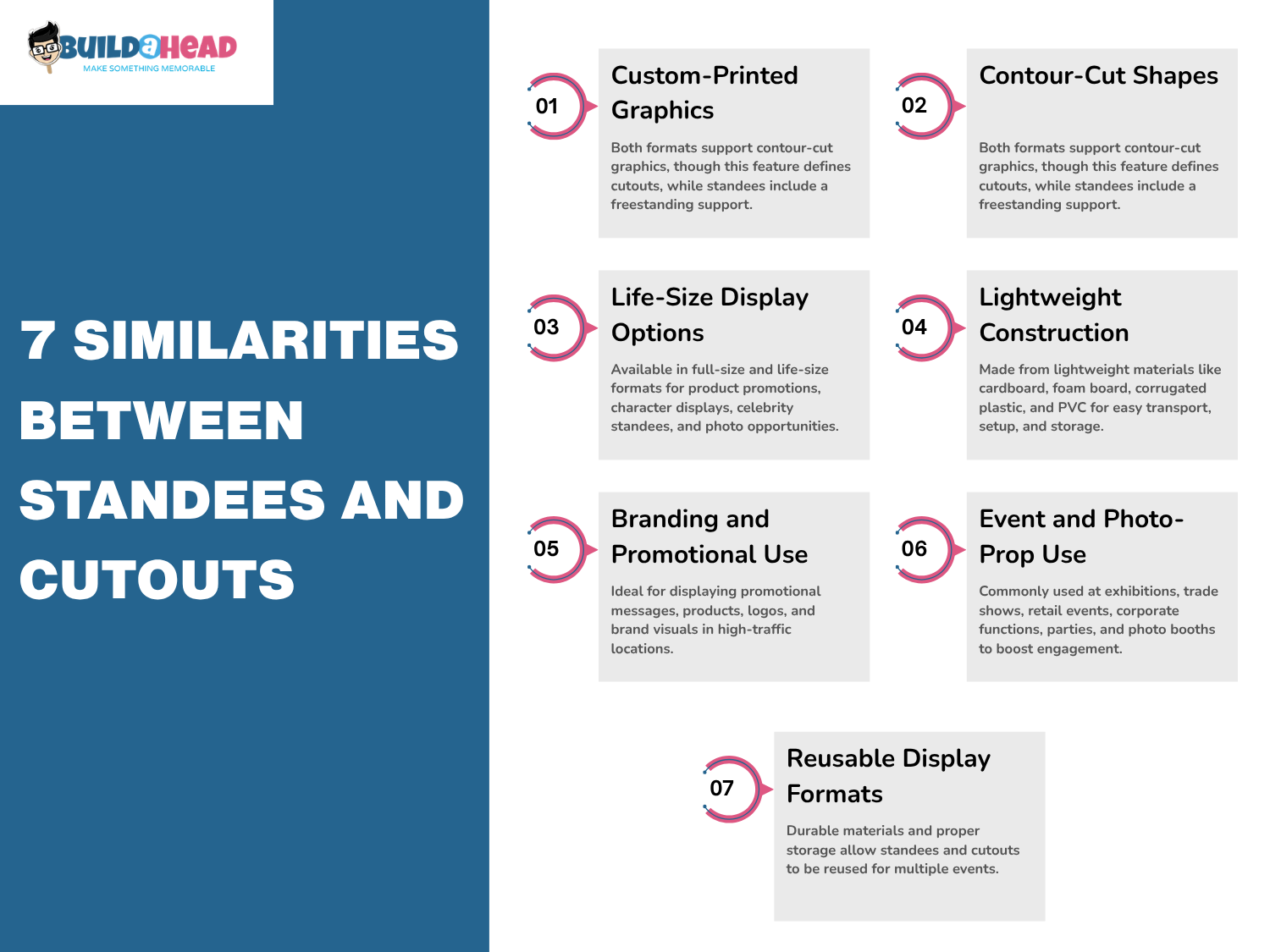
The similarities between standees and cutouts include custom-printed graphics, contour-cut shapes, life-size display options, lightweight construction, branding and promotional use, event and photo-prop applications, and reusable display formats. Although they differ in structure and primary purpose, these shared characteristics make both standees and cutouts effective visual display solutions for advertising, marketing, events, and brand promotion.
Here are 7 similarities between standees and cutouts:
- Custom-Printed Graphics: High-resolution graphics can be customized with brand colors, logos, product images, promotional messages, or event-specific designs.
- Contour-Cut Shapes: Contour-cut graphics are possible for both formats, although they are a defining feature of cutouts, while standees combine the shaped graphic with a freestanding support system.
- Life-Size Display Options: Full-size and life-size formats are available for both, making them suitable for product promotions, character displays, celebrity standees, and photo opportunities.
- Lightweight Construction: Lightweight materials such as cardboard, foam board, corrugated plastic, and PVC make these displays easy to transport, install, and store.
- Branding and Promotional Use: Widely used for advertising and marketing, these displays showcase promotional messages, products, logos, and brand visuals in high-traffic environments.
- Event and Photo-Prop Use: Common applications include exhibitions, trade shows, retail events, corporate functions, parties, and photo booths where they enhance visitor engagement.
- Reusable Display Formats: With durable materials and proper storage, standees and cutouts can be reused across multiple campaigns, events, and promotional activities.
What Are the Pros and Cons of Standees and Cutouts?
The pros of standees and cutouts include high visual impact, customizable designs, lightweight construction, and effective branding for retail, events, and promotional campaigns, while the cons include material limitations, storage or packaging considerations, structural weaknesses, and application-specific support requirements. Neither display format is universally better, as the right choice depends on the intended use, installation method, display environment, and desired visual presentation.
Pros and cons of standees are:
|
Category |
Pros |
Cons |
|
Freestanding Use |
Stand independently with integrated bases or easels, requiring no additional mounting hardware. |
Require dedicated floor space, which may obstruct narrow walkways if poorly positioned. |
|
Quick Setup |
Tool-free assembly with fold-out easels or slot-in bases allows fast installation and removal. |
Repeated folding and unfolding can weaken support panels or hinges over time. |
|
Visibility |
Large display surfaces and upright designs maximize visibility in retail stores, exhibitions, and events. |
Broad panels can become unstable in windy outdoor conditions without weighted bases. |
|
Support Integration |
Built-in support systems provide reliable stability and a clean appearance. |
Rear easels and slot-in bases may wear or loosen with frequent use. |
|
Storage & Shipping |
Flat-pack construction simplifies storage and reduces shipping costs. |
Fold lines may become visible, and larger displays can still require oversized packaging. |
Pros and cons of cutouts are:
|
Category |
Pros |
Cons |
|
Shape Flexibility |
Precision contour cutting creates custom shapes for people, products, mascots, logos, and characters. |
Intricate designs increase production complexity and cutting time. |
|
Photo-Prop Use |
Encourages audience interaction and creates memorable photo opportunities. |
Frequent handling increases the risk of scratches, smudges, and accidental damage. |
|
Mounting Choices |
Can be wall-mounted, suspended, handheld, or paired with optional floor supports. |
Freestanding displays require separate bases, easels, or support hardware. |
|
Structural Balance |
Eliminates unnecessary background material, keeping the focus on the subject. |
Thin edges and extended sections are more susceptible to bending or breakage. |
|
Packaging & Transport |
Lightweight construction makes cutouts easy to carry and transport. |
Irregular shapes require reinforced packaging to protect edges during shipping. |
How to Choose Between a Standee and a Cutout?
Choosing between a standee and a cutout depends on your display objectives, installation requirements, budget, and the type of visual impact you want to create. A standee is better suited for freestanding promotional displays and informational signage, while a cutout is ideal when a custom-shaped graphic or recognizable silhouette is the primary focus.
Choose a Standee If:
- You need a freestanding display that requires no wall mounting or additional support.
- Your display will be used in retail stores, exhibitions, trade shows, or reception areas.
- You want quick, tool-free setup with integrated easels or slot-in bases.
- The primary goal is to display promotional, informational, or directional messages.
- You expect to move, reposition, or reuse the display across multiple locations.
- You need a stable floor display for high-traffic indoor environments.
Choose a Cutout If:
- You want a custom-shaped display that replicates a person, product, mascot, logo, or character.
- The display is intended for photo booths, themed events, movie promotions, or brand activations.
- You require multiple mounting options, such as wall mounting, suspension, or handheld use.
- Creating strong visual impact is more important than displaying large amounts of information.
- Your design includes unique contours or intricate shapes that cannot be achieved with a standard rectangular display.
- You need a display that encourages audience interaction and photo opportunities.
Which Type of Custom Cutout Is Best for Your Event?
The best type of custom cutout depends on the event, available display space, installation requirements, and marketing objectives, including life-size standees, big head face cutouts, and tabletop mini cutouts. While freestanding standees are ideal for delivering promotional or informational messages, contour-cut displays excel at creating memorable visual experiences.
The following recommendations can help you choose the most suitable option for different event types.
- Retail Stores: Product-replica cutouts, branded mascot displays, and point-of-sale promotional figures crafted from durable corrugated plastic or PVC board drive high aisle visibility, resist wear from customer traffic, and feature slot-in bases for easy placement near entrances or endcaps.
- Trade Shows and Exhibitions: Portable character cutouts, full-scale product replicas, and lightweight logo displays printed on foam board or honeycomb board offer flat-pack transport, quick setup inside tight booth footprints, and professional matte finishes for camera-ready booth activations.
- Restaurants and Cafés: Compact countertop menu cutouts, promotional character displays, and seasonal drink-replica props made from wipe-clean PVC or lamination-coated board optimize limited floor space while standing up to accidental spills in high-traffic dining areas.
- Corporate Events and Conferences: Executive speaker cutouts, directional logo displays, and sponsor-branded silhouette panels constructed from high-density PVC or composite board provide polished visual staging, clean wall mounting, and reusable branding across recurring annual summits.
- Weddings and Parties: Life-size couple cutouts, personalized welcome figures, and face-in-hole photo props printed on lightweight foam board or cardboard create memorable keepsake photo opportunities, easily fitted with rear easels or handheld handles for interactive guest fun.
- Movie and Entertainment Promotions: Licensed character cutouts, life-size celebrity figures, and promotional film cast displays printed on high-resolution paperboard or rigid plastic deliver intense visual drama in cinema lobbies, utilizing weighted floor bases to withstand high-volume fan interaction.
- School and Graduation Events: Custom graduate figures, school mascot cutouts, and achievement photo props crafted from weather-resistant corrugated plastic withstand outdoor field ceremonies, sports gyms, and repeated photo sessions year after year.
- Healthcare and Community Events: Educational campaign cutouts, friendly health mascot figures, and wayfinding signage printed on smooth, wipe-clean plastic substrates communicate clear public messages while maintaining hygienic surfaces in community centers and clinic lobbies.
How Much Do Standees and Cutouts Cost?
Standees and cutouts cost $10 to $110+, with prices varying depending on size, customization, and materials. Entry-level tabletop standees or small photo cutouts typically start between $10 and $25, standard life-size cardboard displays range from $30 to $80, and heavy-duty, weather-resistant plastic or composite displays built for extended commercial use can cost $100 or more per unit.
What Factors Affect Standee and Cutout Prices?
Factors affecting standee and cutout prices are display size, material type, standard or custom shape, stand and base type, print quality, order quantity, production time, and shipping charges. Each factor contributes differently to the overall cost, making it important to evaluate your display requirements and budget before selecting the most suitable option.
8 common factors affecting standee and cutout prices are:
- Display Size: Larger displays require more material, printing, and finishing, making them more expensive than smaller tabletop or standard-sized options.
- Cardboard, Foam Board, or Plastic: Material selection significantly affects price. Cardboard is the most affordable, foam board offers a balance of cost and quality, while PVC, acrylic, and corrugated plastic are priced higher due to their durability and weather resistance.
- Standard or Custom Shape: Standard rectangular displays are typically less expensive to manufacture than custom contour-cut designs, which require additional cutting, setup, and finishing processes.
- Stand and Base Type: Freestanding standees with fold-out easels, slot-in bases, metal supports, or weighted bases generally cost more than cutouts without integrated support systems.
- Print Quality and Finishing: High-resolution printing, double-sided graphics, matte or gloss lamination, UV coatings, and specialty finishes add to the production cost.
- Order Quantity: Larger production runs usually reduce the cost per unit through economies of scale, while small or single-unit orders have a higher unit price.
- Production Time: Standard production schedules are generally more cost-effective, whereas rush orders and expedited manufacturing often incur additional charges.
- Packaging and Shipping: Packaging requirements, display dimensions, weight, destination, and protective materials all influence shipping costs, particularly for oversized standees and irregularly shaped cutouts.
Can a cutout be used as a standee?
Yes, a cutout can be used as a standee if it is fitted with a compatible support system such as a rear easel, slot-in base, or floor stand. While a cutout refers to the custom contour-cut shape of the display, a standee describes how the display is supported and presented. Adding a freestanding base allows a cutout to stand independently, combining the visual impact of a custom-shaped graphic with the convenience and stability of a traditional standee for retail displays, events, exhibitions, and promotional campaigns.
Are standees suitable for outdoor use?
Yes, standees are suitable for outdoor use when manufactured from weather-resistant materials and paired with stable support systems. Durable substrates like corrugated plastic, PVC, and aluminum composite panels feature UV-resistant inks and protective finishes that withstand sunlight, moisture, and moderate weather. Conversely, standard cardboard standees are strictly for indoor environments, as rain, humidity, and wind cause rapid warping, fading, and structural collapse. For extended outdoor installations, using weighted bases or ground anchors ensures maximum stability.
How long do standees and cutouts last?
Standees and cutouts can last from a few weeks to several years, depending on the material, display environment, and frequency of use. Cardboard displays are best suited for short-term indoor promotions, while foam board, PVC, acrylic, and corrugated plastic provide greater durability for repeated or long-term use. Proper storage, careful handling, and protection from moisture, sunlight, and physical damage can significantly extend the lifespan of both display types.