
Foam Board vs Cardboard Cutout: Which Material Is Better for Your Custom Display?
Posted by Bruce on Sep 3rd 2026
Foam board is better for custom displays requiring sharp print quality, rigid shape support, and repeated indoor use, while cardboard suits temporary, budget-focused displays that prioritize foldability and compact shipping. The smooth printing surface of foam board reproduces photographs, logos, facial details, and small text clearly. The lightweight foam core also helps life-size cutouts stay flat and stable, making it suitable for trade shows, retail displays, corporate events, branded graphics, and reusable photo cutouts.
Corrugated cardboard uses a flexible, lightweight paper structure that allows large standees to fold into smaller packages for easier transport and storage. This construction suits birthday parties, temporary promotions, casual events, and single-use displays. Repeated folding, moisture exposure, and handling can cause visible creases, warping, or structural wear over time. Your material choice should depend on display duration, environment, print detail, portability, reuse, and budget. Choose foam board for professional, reusable displays and cardboard when lower upfront cost, easy shipping, and short-term use matter most.
Foam Board vs Cardboard Cutout: Quick Comparison
Foam board offers a smoother, sharper, more rigid display with stronger print detail and better reusability, while cardboard is cheaper and easier to fold, ship, and store, making it ideal for temporary, low-cost setups. For professional branding, retail displays, and trade shows, foam board is the stronger choice, while cardboard suits short-term promotions and events where portability, compact shipping, and upfront affordability matter most.
The key differences between foam board and cardboard cutouts are outlined below:
|
Feature |
Foam Board Cutouts |
Cardboard Cutouts |
|
Material Construction |
Polystyrene foam core with smooth, rigid faces. |
Fluted paper core with flexible outer liners. |
|
Print Surface & Detail |
Smooth surface supports sharp, detailed printing. |
Textured surface may reduce fine detail. |
|
Rigidity & Damage |
Resists bending but can dent or chip. |
Flexible but prone to creasing and crushing. |
|
Weight & Portability |
Lightweight but requires flat handling. |
Lightweight, foldable, and easier to transport. |
|
Stand & Setup |
Works with smaller easels or bases. |
Often requires larger rear supports. |
|
Shipping & Storage |
Ships flat and needs dry, supported storage. |
Folds compactly but requires dry storage. |
|
Moisture Resistance |
Paper-faced versions are not waterproof. |
Highly sensitive to water and humidity. |
|
Reuse Potential |
Better for repeated indoor use. |
Better for temporary or short-term use. |
|
Price & Cost per Use |
Higher upfront cost, stronger reuse value. |
Lower upfront cost for temporary displays. |
|
Best Uses |
Trade shows, retail, branding, and corporate events. |
Parties, promotions, and single-event displays. |
- Material construction
Foam board uses a rigid, lightweight polystyrene core sandwiched between paper faces that stays flat over large surface areas, while corrugated cardboard relies on heavy paper pulp or fluted corrugated structures, making it more flexible, foldable, and budget-friendly. Foam core displays cut cleanly via CNC routers or Zünd cutters without exposing rough paper edges, making them the standard choice for professional US trade show exhibits. Cardboard cutouts use Single Wall (E-flute or B-flute) corrugated stock, offering structural elasticity that allows life-size standees to collapse cleanly into standard FedEx or UPS ground shipping boxes.
- Print surface and image detail
Foam board features a clay-coated, ultra-smooth outer liner that maximizes ink density and photographic fidelity, cardboard, by contrast, has a fibrous, absorbent surface prone to flute shadowing (washboarding). High-end commercial printers favor foam core for UV-curable and direct-to-substrate printing, as it accurately reproduces tight typography, dark gradient tones, and high-contrast photography. Cardboard printing, often done via flexography or direct digital printing, delivers vibrant colors for casual signage but struggles with fine-line details because dot gain occurs on the porous faces of kraft or white paper.
- Rigidity and common damage points
Foam board retains structural integrity under vertical loads but is susceptible to corner denting, while cardboard flexes without shattering but can suffer permanent crease damage across its flutes. In high-traffic environments like retail stores or convention halls, a foam board cutout stands upright without leaning or warping. However, drop damage can crush foam edges. Cardboard resists edge chipping, but once a fold line or cross-flute crease occurs, the standee permanently loses structural tension and requires rear splints to stay upright.
- Weight and portability
Cardboard is easier to fold, pack down, and transport for travel, whereas foam board is lighter and smoother but requires rigid, flat handling. For sales representatives or event organizers traveling across the US, a tri-fold cardboard cutout can fit in standard checked luggage or small-parcel packaging. Foam board cutouts remain lightweight but require oversized flat boxes to prevent snapping during transport, which can trigger dimensional-weight surcharges from carriers like UPS and FedEx.
- Stand and setup options
Foam board self-supports cleanly on lightweight aluminum feet or thin adhesive foam easels, while tall cardboard cutouts require heavy-gauge corrugated back-struts or multi-point easel bases to prevent mid-section sagging. Because foam board does not bow under its own weight, back supports can be small and discreet. Cardboard standees require full-length rear spines, often made of heavy E-flute cardboard, to bridge the pre-scored fold lines and prevent the graphic from folding forward under ambient airflow or slight breezes.
- Shipping and storage
Cardboard drastically lowers domestic freight costs through compact, folded shipping sizes, whereas foam board requires flat, crate-style packaging to preserve its pristine outer surface. In the US e-commerce fulfillment sector, shipping a folded 6-foot cardboard cutout costs significantly less by ground freight than shipping a full 4x8 ft flat sheet of foam board. For storage between annual events, foam board must be stored vertically in slotted racks or laid flat under a light cover to prevent surface denting, while cardboard must be kept in a climate-controlled environment to prevent absorption of ambient moisture.
- Moisture and outdoor suitability
Standard foam board tolerates short-term ambient indoor humidity much better than cardboard, but neither standard material will withstand direct rainfall without specialized waterproof facers or plastic cores (such as Sintra or Coroplast). Cardboard quickly absorbs atmospheric moisture, causing the flutes to soften, warp, and delaminate within hours of exposure to humid outdoor conditions or damp venues. Standard paper-faced foam core will eventually bow if left outdoors overnight, though outdoor-rated expanded PVC foam (Gatorfoam or Sintra) offers a fully waterproof alternative.
- Reuse potential
Foam board provides superior multi-event durability for recurring corporate campaigns, whereas cardboard is engineered primarily as a single-use or short-term promotional substrate. Commercial marketers managing multi-city roadshows select foam board because the edges and print surfaces survive repeated assembly, teardown, and repacking. Cardboard cutouts degrade rapidly at the hinges, easel attachment points, and corner edges after two or three setups, making them best suited for single-day promotional events or private parties.
- Upfront price and cost per use
Cardboard can reduce upfront material costs, while foam board may provide better value when reliability and repeated use matter. In one documented $6,000 order, cardboard offered a 40% lower material cost than foam board, but warped pieces and peeling edges led to a rejected batch, a $3,200 redo, and a one-week delay. This case shows why buyers should compare initial price with replacement risk, display duration, and overall cost per use rather than purchase cost alone (source: Jane Smith, June 3, 2026)
- Best uses
Foam board is a benchmark material for premium corporate branding, retail visual merchandising, and high-resolution presentation displays, whereas cardboard remains a preferred option for budget-conscious, high-volume, and short-term promotional standees. Choose foam board when visual presentation, sharp imagery, and crisp contours represent your brand image at industry conferences or long-term retail placements. Choose cardboard when low-cost unit economics, easy flat-pack distribution, and casual single-event setup dictate your project requirements.
What Are Foam Board and Cardboard Cutouts Made From?
Foam board cutouts are made from a lightweight polystyrene foam core placed between smooth printable outer layers, while cardboard cutouts use corrugated paper with two flat liners surrounding a fluted inner layer. These different material structures determine each cutout’s rigidity, print surface, weight, foldability, and durability. Foam board creates a rigid, smooth display suited to detailed printing and repeated indoor use, while corrugated cardboard creates a flexible, lightweight standee suited to folding, compact transport, and temporary displays.
How Is a Foam Board Cutout Constructed?
A foam board cutout is constructed by scaling and printing a digital image, mounting the print onto a lightweight polystyrene foam core with a strong adhesive, contour cutting the precise shape, and attaching a stabilizing easel or structural stand to the back. The rigid foam core supports the printed surface while keeping the custom cutout lightweight. Precise cutting can reproduce people, products, letters, and logos, while the rear support helps the finished foam board cutout remain stable during display and repeated indoor use.
How Is a Corrugated Cardboard Cutout Constructed?
A corrugated cardboard cutout is constructed from a lightweight paper sandwich structure that combines strength, flexibility, and foldability for temporary displays. Two flat outer liners surround a wavy inner layer called the flute, and the layers are bonded together with cornstarch-based adhesive. After printing, large cutting equipment shapes the cardboard into the required contour. Pre-scored sections can support folding for compact transport, while a rear easel, corrugated spine, or base supports the finished cardboard cutout and helps it remain upright during display.
Which Material Produces Better Print Quality: Foam Board or Cardboard?
Foam board produces sharper, smoother, and more detailed print quality than cardboard, making it the stronger choice for photographs, logos, facial features, and professional branded graphics. Cardboard can still produce vibrant printed displays, but its paper-based surface can limit the reproduction of fine detail.
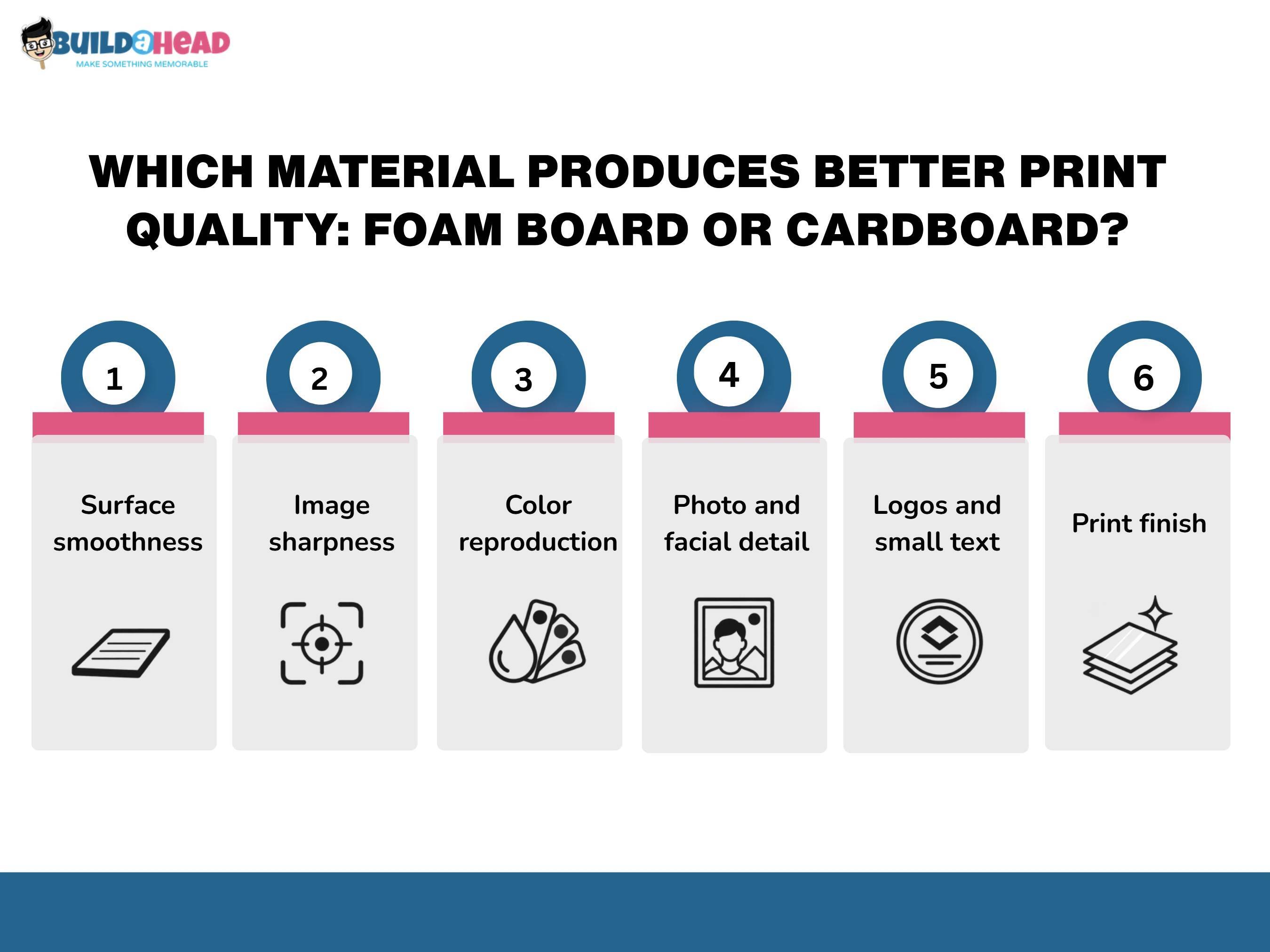
Reasons why foam board often delivers better print quality include:
- Surface smoothness
A smooth, uniform outer liner gives foam board a cleaner printing surface than corrugated cardboard's fibrous paper face. Consistent surface texture supports controlled ink placement and a polished appearance across photographs and branded graphics. Cardboard surfaces can reveal paper fibers or flute patterns, particularly across large printed areas, making the finished cardboard cutout appear less uniform at close viewing distances.
- Image sharpness
Direct-to-substrate printing on rigid foam board produces razor-sharp vector lines, fine typography, and crisp logo boundaries. Cardboard’s porous surface causes ink bleed and surface washboarding, which degrade the legibility of small text. Foam board stays flat, keeping geometric brand elements and intricate lettering legible and shape-accurate without warping or edge distortion.
- Color reproduction
Foam board supports glossy, matte, and laminated coatings that maximize ink density, deepen color saturation, and control glare under event lighting. Cardboard relies mostly on uncoated or lightly coated paper liners that absorb ink rapidly, yielding muted colors and flat tones. Protective laminates on foam board also guard against minor surface scratches, preserving brand color accuracy.
- Photo and facial detail
High-resolution photographs retain clearer eyes, hair, skin tones, facial edges, and other detailed elements on the smooth surface of foam board. This makes a life-size foam board cutout suitable for people, pets, mascots, and photo displays where realistic reproduction matters. Cardboard remains useful for casual standees, but its surface texture can reduce definition in detailed facial features and photographic transitions.
- Logos and small text
Intricate logos, thin lines, lettering, and small text benefit from foam board's rigid, smooth printing surface, which helps maintain clean contours and readable details. This performance suits corporate events, retail displays, and branded cutouts where graphic accuracy matters. Cardboard performs well with larger logos and lettering, but very small elements may lose definition due to the paper's texture and ink absorption.
- Print finish
Matte, gloss, laminated, and coated finishes can give printed foam board different levels of glare control, color appearance, handling resistance, and surface protection. A matte finish can reduce reflections around photo displays, while suitable coatings can protect printed graphics during repeated handling. Cardboard can also accept different print finishes, although its underlying paper texture and corrugated construction can still influence the final surface appearance.
Which Cutout Material Is More Durable for Indoor, Outdoor, and Repeated Use?
Foam board offers greater durability for repeated indoor use, whereas cardboard is more susceptible to moisture, bending, and structural wear. Cardboard can absorb water and humidity quickly, causing its paper structure to soften or warp. Standard paper-faced foam board can also warp or delaminate after exposure to moisture, so neither material is waterproof. For outdoor displays, PVC foam board and other weather-rated substrates have different levels of moisture resistance and should be evaluated separately.
The key factors that show how each material performs under different conditions are:
- Resistance to bending and creasing
Rigid foam core helps a cutout remain flat during carrying, setup, display, and storage, reducing the risk of permanent fold lines. Corrugated cardboard provides greater flexibility and can be folded for compact shipping, but repeated bending can create visible creases that remain after setup. Large foam board cutouts still require careful carrying and flat support because narrow sections can bend under pressure.
- Performance during repeated handling
Repeated unpacking, carrying, setup, removal, and storage favor foam board because its rigid construction maintains a cleaner display shape. Cardboard can support repeated handling, but folding points, corners, and stand attachments can show wear sooner. Keeping foam board flat and cardboard properly folded during transport helps reduce damage, while protective packaging supports longer usable performance for both custom cutout materials.
- Resistance to Dents
Impact affects each material differently. Foam board can develop dents, compressed corners, or chipped edges when pressure reaches its outer surface or exposed foam core. Cardboard is less prone to foam-edge chipping but can crush, buckle, or develop permanent crease lines across its corrugated structure. Protective packaging, supported carrying, and careful stacking help reduce pressure damage during shipping, storage, and repeated event handling.
- Moisture Performance
Cardboard absorbs water and humidity more readily, which can soften its paper structure and cause warping or separation. Standard paper-faced foam board also remains vulnerable to moisture and may bow or separate after exposure. Neither should automatically be considered waterproof. PVC foam board and other weather-rated substrates have different moisture properties and are a better choice when outdoor exposure is required.
Which Cutout Material Is Easier to Transport, Set Up, and Store?
Cardboard is easier to transport when foldability and compact shipping matter, while foam board provides a flatter, more rigid presentation for repeated setup. Both materials require dry indoor storage with full support and protection from pressure and heat. Poor storage can cause foam board to bow, dent, or develop surface marks, while cardboard can crease, crush, or lose its stable shape.
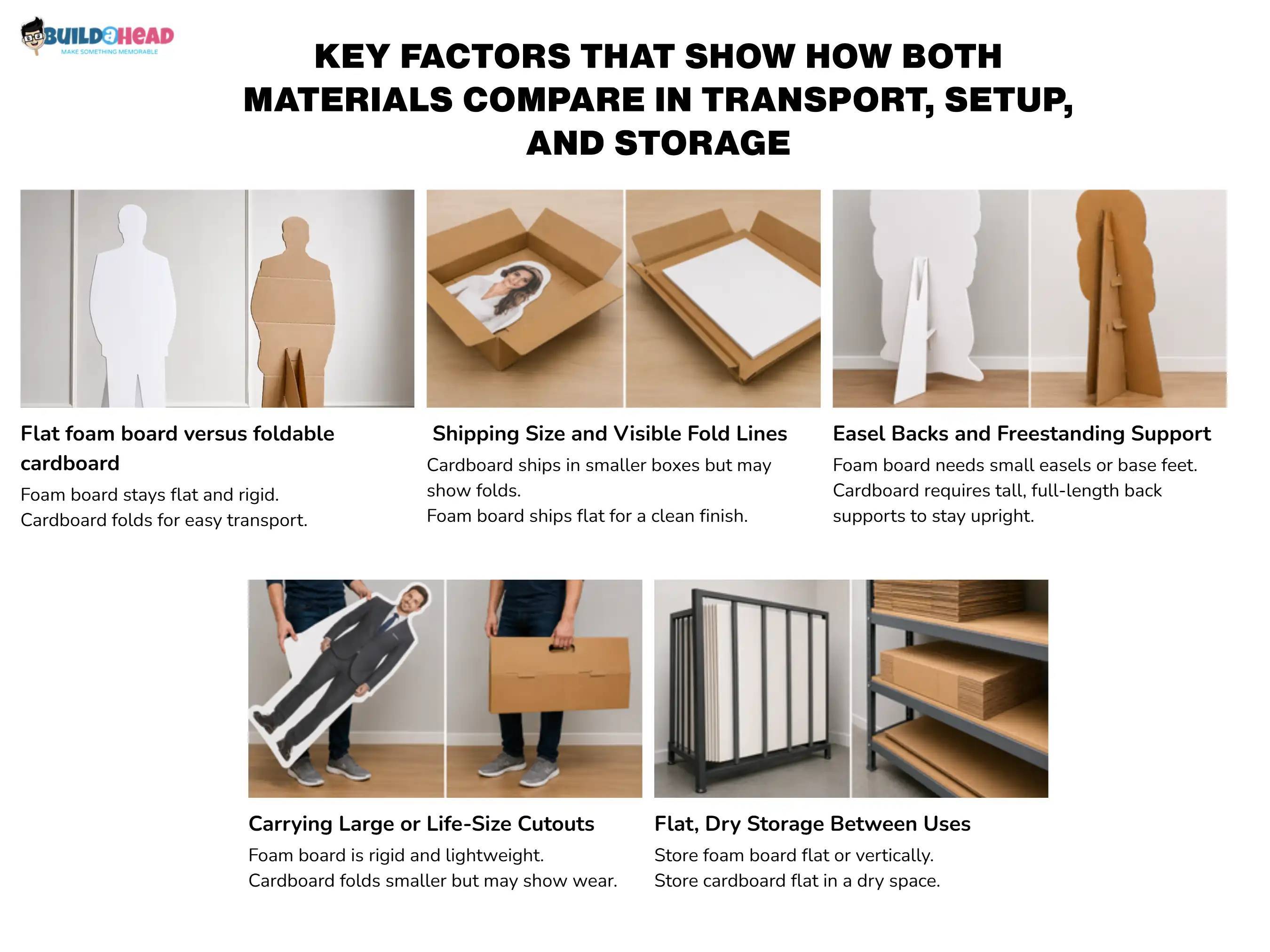
Below are the key factors that show how both materials compare in transport, setup, and storage:
- Flat foam board versus foldable cardboard
Foam board remains completely flat and rigid, preserving your graphic without unsightly fold lines. Cardboard features pre-scored hinges that allow life-size standees to collapse into compact shapes. Choose foam board when visual quality, durability, and shape retention are critical; select cardboard for lightweight portability, effortless travel between locations, and short-term, budget-friendly promotional setups.
- Shipping size and visible fold lines
Foldable cardboard standees fit into smaller shipping boxes, drastically lowering domestic parcel freight costs. However, pre-scored fold lines often remain visible across the printed image once assembled. Foam board must ship flat in oversized packaging to protect its core, resulting in higher freight expenses but guaranteeing a flawless, crease-free face for professional corporate environments.
- Easel backs and freestanding support
Foam board naturally holds its structural integrity, requiring only small, discreet rear easels or aluminum base feet to stand upright. In contrast, cardboard cutouts flex easily, especially along fold lines, and demand tall, full-length rear cardboard spines. Without these heavy-duty supports, cardboard standees can bow, sag, or fold forward under ambient indoor airflow and air conditioning.
- Carrying large or life-size cutouts
Large foam board cutouts remain lightweight but require careful handling because their rigid shape cannot be folded for compact transport. Cardboard life-size cutouts can incorporate folds that reduce carrying size, although repeated folding can create visible wear. For sponsor displays, speaker cutouts, conference signage, and stage branding, foam board supports a professional presentation, while cardboard suits informal or one-time internal events.
- Flat, dry storage between uses
Store foam board vertically in slotted racks or completely flat on clean surfaces to prevent bowing, surface denting, and edge chips. Cardboard requires flat storage in strictly climate-controlled environments; absorbing ambient humidity quickly softens its internal paper flutes, leading to permanent warping, mold risks, and structural collapse before your next scheduled display or promotional campaign.
Which Cutout Material Is Better for Different Uses?
For professional, detailed, reusable indoor displays, foam board is a better option, while cardboard works well for temporary, lightweight, affordable applications. The right choice depends on display purpose, handling, and reuse. Rigid foam core provides a smooth print surface but can dent or chip, while corrugated cardboard supports compact handling but is more vulnerable to creasing and moisture.
Which Cutout Material Is Better for Trade Shows?
Foam board is better for most indoor trade show displays because its rigid, smooth construction supports detailed printing, custom shapes, and repeated use. Logos, product graphics, and branded cutouts can retain a clean presentation across multiple setups. Its limits include higher potential cost, dented or chipped edges, and limited weather resistance in standard paper-faced products. Cardboard remains practical for single-use trade show graphics where affordability carries greater priority.
Which Cutout Material Is Better for Retail Displays?
Rigid foam board is better for retail displays that must stay flat and visually clean throughout a promotion. Its strong shape support is well-suited to product cutouts, branded signage, and point-of-sale displays where presentation and repeated indoor use matter. Oversized foam board pieces may still require a suitable stand or base to remain stable. Cardboard is practical for temporary retail campaigns where short-term use and affordable materials take priority.
Which Cutout Material Is Better for Corporate Events?
A smooth foam board surface makes it the stronger choice for corporate events where clear logos, photographs, facial features, and branded graphics are key to the presentation. Detailed printing supports speaker cutouts, sponsor displays, stage branding, conference signage, and office event graphics. Its rigid structure also keeps printed shapes clean and crisp during display. Cardboard provides an affordable alternative for informal celebrations or one-time internal events where detailed reproduction and repeated use are less of a priority.
Which Cutout Material Is Better for Photo Booth Props?
Foam board is better for reusable photo booth props and complex custom contours because its rigid construction supports defined shapes without excessive flexing. You can contour-cut people, products, letters, logos, and photo frames while keeping edges clean and printing detailed. Cardboard works well for lightweight, temporary props that will be discarded after an event. Narrow or complex foam shapes may still require suitable support and careful handling.
Which Cutout Material Is Better for Weddings, Birthdays, Graduations, and School Events?
Foam board is the best overall cutout material for weddings, birthdays, graduations, and school events because it combines lightweight construction, affordability, and easy setup. Corrugated plastic is better suited to outdoor events where moisture resistance matters, while acrylic is better suited to premium keepsakes. Cardboard provides an economical, temporary choice for indoor table decorations and other short-term event displays.
What Are the Pros and Cons of Foam Board and Cardboard Cutouts?
Foam board offers a rigid surface, smooth print finish, strong shape support, and better repeat-use performance, but it can cost more, suffer chipped edges, and resist weather poorly. Cardboard offers lower cost, lightweight construction, easier shipping, and practical short-term use, but it bends and creases more easily, absorbs moisture readily, and has a shorter usable lifespan than foam board.
What Are the Pros and Cons of Foam Board Cutouts?
Foam board cutouts provide a rigid, smooth, lightweight display surface that supports detailed printing and repeated indoor use. Their main limitations are higher potential cost, vulnerable edges, and limited weather resistance.
Pros of Foam Board Cutouts:
- Rigid display surface: The rigid foam core helps the cutout remain flat and prevents unwanted flexing during indoor display.
- Smooth print finish: A uniform printable surface supports sharp photographs, clear logos, defined text, and high-quality branded graphics.
- Strong shape support: Foam board retains custom contours well, helping people, products, letters, and logo cutouts maintain their intended shape.
- Better repeat-use performance: With careful handling and dry storage, foam board can withstand repeated transport, setup, display, and storage better than cardboard.
Cons of Foam Board Cutouts:
- Higher cost: Material, printing, contour cutting, protective packaging, and shipping can increase the upfront cost compared with a temporary cardboard cutout.
- Risk of chipped edges: Corners, narrow sections, and exposed edges can dent or chip when the cutout experiences impact or pressure.
- Limited weather resistance: Standard paper-faced foam board is not waterproof and can warp or separate after moisture exposure, limiting its suitability for outdoor displays.
What Are the Pros and Cons of Cardboard Cutouts?
Cardboard cutouts offer an affordable, lightweight, portable option for temporary displays, but their flexible paper construction resists bending, moisture, and repeated handling less well.
Pros of Cardboard Cutouts:
- Lower cost: Cardboard provides an economical material choice for one-time parties, temporary promotions, novelty standees, and other short-term displays.
- Lightweight construction: Corrugated paper keeps large, life-size cardboard cutouts light enough to carry and set up easily.
- Easier shipping: Foldable sections can reduce parcel dimensions, making cardboard practical when compact shipping and transport are a priority.
- Good for short-term displays: Cardboard works well for indoor events, temporary campaigns, and special occasions where long-term reuse isn't needed.
Cons of Cardboard Cutouts:
- Lower resistance to bending: Corrugated cardboard can flex, bow, crush, or develop permanent creases during transport, setup, and storage.
- Greater moisture sensitivity: Water and humidity can soften the paper structure, causing warping, loss of rigidity, or surface damage.
- Shorter usable lifespan: Repeated folding, carrying, and setup can wear down corners, fold lines, and support points sooner, reducing performance over repeated use.
How Should You Choose Between Foam Board and Cardboard?
Choose foam board when rigidity, detailed printing, professional presentation, custom shapes, and repeated indoor use matter most. Choose cardboard when lower cost, compact shipping, and temporary use carry greater priority. Foam board cutouts can support repeated use when stored dry, handled carefully, packed securely, and protected around the edges. Display environment, duration, portability, support, and budget should guide the final material choice.
Is Foam Board Better Than Cardboard for Cutouts?
Yes, foam board is better than standard cardboard for visual cutouts because its smoother printing surface produces sharper graphics, while its rigid foam core helps maintain a clean, stable shape. Cardboard is more suitable for temporary, budget-focused displays that prioritize foldability and compact transport.
Are Foam Board Cutouts Waterproof?
No, foam board cutouts are not waterproof and should not be treated as outdoor-rated displays. Water or prolonged humidity can affect the paper facers and cause the board to warp or separate. For controlled indoor environments, foam board provides rigid construction and a premium presentation. Outdoor applications require a weather-rated substrate, such as PVC foam board, rather than assuming every foam core product offers the same moisture resistance.
Can Cardboard Cutouts Stand on Their Own?
No, cardboard cutouts cannot reliably stand upright without a rear easel, folding stand, base, or another support system, as stability depends on the cutout’s height, width, contour, and weight distribution. Tall, narrow, or top-heavy life-size cardboard cutouts require stronger rear support than smaller shapes. A suitable stand distributes the load and helps prevent the flexible cardboard structure from leaning, bowing, or folding forward during indoor display.
Which Material Is Better for Life-Size Cutouts?
Foam board is better for premium or reusable life-size cutouts because its rigid structure supports detailed printing, facial clarity, and stable custom contours. Cardboard is better suited to a one-time life-size display where affordability and compact shipping matter more. Both materials can reproduce people, characters, and other full-size graphics, but the final choice should consider stand stability, transport requirements, expected reuse, and required presentation quality.
Is Foam Board Worth the Higher Cost?
Yes, foam board is worth the higher cost for cutouts that require sharp print quality, rigid shape support, and repeated use. Standard 20" x 30" foam board sheets may cost around $2 to $5 per sheet, depending on thickness, brand, and quantity. Its value becomes clearer for trade shows, retail promotions, and corporate events where professional presentation matters. Buyers should compare expected usage, replacement frequency, printing, packaging, shipping, and overall cost per use.
Can Foam Board Be Cut Into Custom Shapes?
Yes, foam board can be contour cut into custom shapes such as people, logos, letters, products, characters, symbols, and directional displays. The cutting process follows a prepared cut path around the printed artwork to reproduce the intended outline. High-quality artwork and accurate cut-path preparation support cleaner results. Narrow sections, projecting shapes, and complex contours may require careful handling or added support to help the finished foam board cutout retain its shape.